Showing posts with label lit talk. Show all posts

Monday, October 21, 2013

Fight for Equality (In a Time of Global Warming)


It's important to look at the variations in our world as being things that not only add color and interest to the universe but create a solid ground whereupon we can journey onward in our fight for equality.

Every day we see our species working toward honoring different perspectives and welcoming variations of all types; however, there's neverending work to be done in this voyage toward acceptance. Ignorance and hate, as looming entities, will always exist--but, if we fight hard, perhaps we can all strive to make the world a more welcoming place for everyone, without discriminating them based upon their backgrounds, cultures, or perspectives. 

I'm an optimistic person, and always strive to see the good, and will continue be an advocate for this notion that great power rests in the existence of variation, variability, and diversity.

~~~

I recently read Francesca Lia Block's Love in the Time of Global Warming, a piece of YA fiction with a wonderfully diverse set of characters on an Odyssey-sized adventure: totally epic in a quiet, literary sort of way. Her voice is unlike any other's, and her careful attention to language makes one wonder if each sentence was cut with a diamond. The story got me thinking not only about the importance of diversity in YA literature but how important it is to fight for equality--of every kind--within our everyday lives. Literature is just one of the many tools that can aid in this fight.

[Header image by Nick]

Friday, May 24, 2013

Let's Get Sexual: Sex in YA Lit


As a YA writer, it's always interesting to hear how others deal with sex in their work. Carrie Mesrobian, author of the forthcoming Sex & Violence (Carolrhoda LAB, Oct. 2013), and editor Andrew Karre talked about sex in YA lit at the Children's and Young Adult Literature Conference at The Loft Literary Center in Minneapolis. 

I wasn't in attendance; however, I stumbled across their main points of discussion on Mesrobian's blog (via YA Highway) and they're quite enlightening--especially if you're always thinking about how young adults/new adults view or contemplate sex, both inside and outside the realms of fiction.

Two points (as outlined by Mesrobian) I find particularly enlightening:

1. You can write YA that doesn't have sexual content in it. What you cannot do is write imaginable young adult characters without thinking about them with respect to sex.

6. Adolescence, the notion of childhood innocence, and the concept of privacy are all relatively modern inventions. Reluctance to speak about sex or even expose children or young adults to sex has not always been the norm throughout human history. Also, teenagers have very little privacy in general, less now in the social media age. YA stories that feature long expanses in which characters have uninterrupted romantical sex are in conflict with this reality.

Friday, March 22, 2013

Chinua Achebe: The Bravery, even, of the Lions


Chinua Achebe was a great writer and perhaps most famously known for his work Things Fall Apart. As a student, I actually read the assigned material (as opposed to my Sparknoting colleagues) and this piece, an intimate examination of colonial powers and their influence on traditional African culture, will always be one of those works of literature that I carry with me.

The literary world recently lost this great writer at the age of 82 and, in memoriam of his passing, I think we should all remember what great works of literature have the power to do: tell people's stories that otherwise might not be told or heard.

In a 1994 interview with The Paris Review, Achebe contemplates the importance of telling all sides--every side--of the story:

"There is that great proverb — that until the lions have their own historians, the history of the hunt will always glorify the hunter. That did not come to me until much later. Once I realized that, I had to be a writer. I had to be that historian. It’s not one man’s job. It’s not one person’s job. But it is something we have to do, so that the story of the hunt will also reflect the agony, the travail — the bravery, even, of the lions."


The bravery, even, of the lions.


Monday, March 4, 2013

Magical Realities, Perspectives, and the Human Condition: What Does Fantasy Do?


As a person and writer, I've never been able to look at a rock and see just a rock. The rock might grow a pair of legs and walk about the world, wondering why he's been given such a hard exterior in a land full of soft things, or that same rock might sprout a pair of wings and desire a home in the nest of an eagle. Perhaps I'm prone to disregarding the rules and laws of our world because I never quite meshed with my Organic Chemistry and Physics textbooks; or, perhaps, I gravitate toward this magical way of thinking because it is how I come to interact with and wrap my head around the confusing experiences of life.

For me, it's important to embrace this idea of other within literature because it encourages us to stand on our heads and view the world from a different perspective: a fantastical way for us to understand the human condition and experience.

I tell fantastical stories because I don't believe in saying to a character, You have to stop now--you can't go any farther because reality tells you no. I tell fantastical stories because I live for that moment when a character stumbles over that word no and does something special with it. There are many heavy things in this world, and it is my greatest pleasure as a writer to see how a character will interact with that weight: How might he lift it? How might she movie it? How will their directions change once that weight rests in their hands? [These questions might easily be applied to all genres of literature, including realistic--how might they take on different meanings?]

I tell fantastical stories because what if always has and always will intrigue me.

For me, a successful piece of fantastical literature conveys the notion that we don't always have to participate in the traditionally accepted versions of reality in order to understand ourselves and the inherent qualities that make us human. In my eyes, the goal of fantastical literature is to break apart the world we've come to know and, using all those pieces, a combination of recognizable things and never-before-seen things, slowly and carefully snap the universe back together again.

Sunday, December 2, 2012

Nominated for a Pushcart Prize!


One of my short stories, "Nogoodfornothin'," published in the Spring 2012 issue of the Conium Review, has been nominated for a Pushcart Prize!

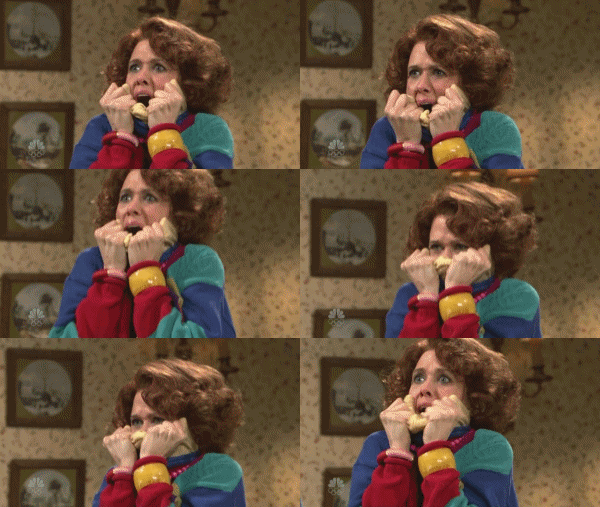
My reaction:


Sunday, November 25, 2012

The Difference Between Fantasy Lit and Science Fiction Lit


One of my all-time fave writers is Ursala K Le Guin; I guess you could say she's somewhat of a hero of mine. In a great interview with Bill Moyer on PBS (video below), she talks about what she feels is the main difference between the genres of fantasy and the genres of science fiction. 

According to Le Guin,

"Science Fiction doesn't contradict science, but it goes on and invents just as freely as fantasy does."
"Fantasy makes up its own rules; it's a much older genre; its roots are deeper." The happenings in a story of fantasy don't necessarily have to align with our current understandings of physics--laws of the world.

Isn't this such a wonderful way to look at these two genres? So often time they are lumped together as Science Fiction & Fantasy--with that misleading ampersand that, in my mind, seems to suggest some extremely close correlation. 

Sure, they are similar genres, but each has its unique perspective and ways in which it critiques a universe.

Saturday, November 17, 2012

Rain, Rain, Is Here to Stay!


The Pacific Northwest rains are finally here to stay, and some days I feel like scuba gear is required to successfully traverse the wet streets. Lots of people hate the rain, but I have to admit there's nothing I enjoy more than a nice, large, juicy rain cloud.

The soggy clothes. The chilly weather. The big warm jackets. The mandatory cups of hot chocolate (or, as I've recently discovered, mochas from Starbucks). The heaters. The blankets. The lack of sunshine/lack of sunburns. I love it all.

Rain: Is there really a better excuse to stay in the house and write, write, write or read, read, read?

Monday, October 29, 2012

Sparkly, Shiny, Fresh-Smelling New Ideas!


The fantastic thing about writing stories--about stumbling into new worlds--is that you never know when they might pop up. You could be sitting in a classroom listening to your professor ramble on and on, you could be at work pounding away on that computer, or you could even be pleading to the Celeb Gods that they fix crazypants Lindsay Lohan.

But whenever that sparkly, shiny new idea creeps up on you, it's basically mandatory that you show the world how happy you are.

funny gifs

That happiness will ensue for many days, many weeks, perhaps even many months, until suddenly . . . your shiny new world begins to present problems and conflicts and struggles. And then you get sad, because conflict sort of stresses you out:

funny gifs

And you know what you want your characters to say, you know what you want them to achieve and where you want them to go on their journey, but sometimes you just can't reach the carrot:

funny gifs

But then, as you explore this world more and love this world more and meet new faces within this world and hear all the stories this world has to share, then that joy comes back again:

funny gifs

And then you have to edit the sucker . . . . and we all know how that feels:

funny gifs

Thursday, October 18, 2012

Keeping it Real in YA Lit


I'm so lucky that I'm a Pacific Northwesterner and had the opportunity to check out Wordstock 2012! Authors, young writers, local publishers, readers, and word-lovers of all types showed up at the Oregon Convention Center this past weekend for an incredible literary celebration. 

I attended several YA panels and discussions, which quickly turned out to be the highlight of the convention. I find it so interesting to hear how other YA writers approach their work, especially when having to deal with subject matter that is tough, honest, and, for lack of a better term, real. 

Young Adults read this category to find themselves within the stories--to get to know a character that may or may not be dealing with similar issues. On the opposite side of the spectrum, adults read in this category to recapture the magic and experience of their earlier years, and for this reason I agree with author Steve Brezenoff, who said something to the extent of . . . . 

YA should be viewed as a perspective, not necessarily a genre and/or demographic. 

This discussion was called The "Adult" in "Young Adult" and featured authors Joelle Anthony, Steve Brezenoff, Kristen-Paige Madonia, and moderator Erica Lorraine Scheidt. The looming question that drifted throughout the room was what exactly is "adult" subject matter? How do we treat these issues that many adults and institutions have deemed "dangerous" or "too adult" for teenagers to explore?

While many had varying opinions, a couple of the authors raised the idea that it seems ridiculous to even classify the things people take issues with in YA fiction (such as sex, drugs, language, sexuality/identity, etc.) as being "adult" at all . . . because "adult" issues are quite different from "teen" issues, and both demographics perceive issues and interact with issues in very different ways. 

Many teens use literature to explore these sensitive issues and, as suggested by David Levithan at the end of the Keeping it Real discussion, "It's not dangerous to write about tough issues; it's dangerous not to write about them." The danger exists in holding back and not writing about something solely out of fear that the issue explored will garner negative criticism; it's important to remember that young readers need to read about issues that affect them and are pertinent to their lives. 

They need to know that their journeys aren't the only ones. So let's keep it real. Always. Aaragorn demands it.

Image created with memegenerator

Thursday, September 6, 2012

Music for Writers: Action Scenes!

Sometimes it just takes some good music to get pumped up for a scene--especially an action scene! Action scenes are difficult to write, so I am constantly looking for inspiration. When I'm writing, I tend to classify action scenes in one of two ways.

1. Fights/Tussles/Epic Battles. Punches thrown, heroes/heroines knocked down, enemies overcome, maybe some blood. The ones that contain the physical, physical, physical!

2. The Intense. There might not be any fighting in the scene necessarily, but there might be an incredible sense/feeling of needing--needing to get somewhere, needing to succeed, needing to overcome an obstacle. Maybe a character is running down the street, in a thunderstorm, where the only enemies on the course are his own inner demons. Sometimes the greatest antagonists in a novel are those found within the character--those enemies they battle throughout the entire story and, sometimes, feel as if they'll never be able to thwart.

Regardless of what type of action scene you're writing, your characters need something to lift them up after they've fallen and, most of all, inspire them to be victorious. Every once in a while, we all need something that makes us want to run out and take on the world, right?

The following is my playlist that helps me find inspiration for some good ol' action and intensity! What songs get you pumped up for action?

Friday, August 24, 2012

Character Therapy


I just realized that my characters do the following things a lot:

1. "Grab a shoulder" (I think this is in an effort to console the other individual; however, now that I think about it . . . it might just be a bit creepy. How often does someone grab your shoulder *and squeeze it* when trying to comfort you? Stop it, characters, stop getting so cheeky. I'm not a romance writer--I wouldn't know what to do with you once you got past the shoulder groping stage!)

2. "Sigh" (Quite possibly the lamest character action ever. #BasketCase #GetOverIt)

3. "Roll their eyes" (Stop giving me and your peers attitude, you mean-angsty-McNasty!)

4. "Tense up" (Chillax, dudes!)

5. "Crack a grin" and, on the opposite side of the spectrum, "Crack a frown" (There's a whole bunch of "cracking" going on--y'all's faces are goin' to be in some pieces soon . . . then what are we going to do?)

Basically, I'm going to start requiring all of my potential protagonists/antagonists/super-random-agonists to enroll in Character Therapy before they even consider hopping into my head. I work for a celebrity gossip/entertainment news site and deal with Hollywood's crazy drama all day. So, my lovely and sweet and manic characters, give me a break, would ya? I understand that some of you simply must roll your eyes every so often, but please don't do it every third paragraph. It STRESSES me out.

What are some of the things your characters do too often?

Sunday, July 15, 2012

We Have Dreams; Dreams Have Us


It's so hard to wait. Waiting for things is no fun whatsoever--especially for a writer who, more than anything else, wants to see his words out in the world (and, even before that, loved by an agent and, sometime after that, loved by an editor).

I'm querying one of my projects right now and, at times, it can be discouraging. Am I good enough? Will they like the story well enough to take a chance with me? All these questions rumble through a writer's head . . . .

However, I'm reminded of something a professor at my university recently said to me:

"We all have dreams but dreams also have us."


As long as we have our dreams, there to guide us, lift us, push us, always there to make sure we see the possibilities and the magic in the world, then they will one day--one can only hope--embrace us just as we have embraced them.

Image: "The Dream" by Franz Marc